


Our Curriculum at Lethbridge
Firm Foundations, Bright Futures
| Art | Computing | DT | English |
| French | Geography | History |
| Maths | Music | PE |
| PSHE | RE | Science |
Maths at Lethbridge
Intent
Maths is a vital skill for everybody in everyday life so Lethbridge endeavours to make it enjoyable and engaging in order to promote a positive attitude and a life-long love of maths.
Maths is contextualised so children can see how it relates to real life situations providing them with the confidence to enquire, reason and problem solve. We encourage children to express ideas fluently, using mathematical vocabulary, and know they are in a safe environment where they are able to take risks and participate even when feeling unsure. Children are taught to persevere and we aim to stimulate curiosity. The needs of every child is at the forefront of our minds, so that children are supported and challenged at an appropriate level.
We provide opportunities for regular, practical, hands-on learning. It is important that lessons are interactive and children are making connections between prior learning and knowledge, in order to build upon what they already know. Progression is achieved through manageable steps and we have a systemic approach to ensure we teach all aspects of the National Curriculum at a deep level.
Our curriculum across the years
The curriculum is delivered through the implementation of ‘Development Matters’ in EYFS and ‘The National Curriculum’ in both discrete lessons and through other subjects areas where appropriate. Mathematics is generally taught every day through a discrete mathematics lesson, usually lasting between 45 and 60 minutes for Key Stage 1 and Key Stage 2 with shorter sessions in Early Years. This time varies according to age group. However, where appropriate, some mathematics lessons may be taught in a cross curricular manner. This may either be in addition to the children’s daily lesson or occasionally it may replace it.
Lessons will:
- have a clear focus, following a sequence of small connected steps - children are aware of the learning objectives
- be interactive, enjoyable and relevant
- provide opportunities for children to orally explain their mathematical thinking
- support learning through clear modelling and adaptations to ensure everyone can succeed
- include both teaching input and pupil activities, with a balance between whole class, grouped, paired and individual work
- include a variety of representations over time, encouraging children to make connections and develop a deep understanding
- have appropriately timed plenaries /reviews/inputs from the teacher which involve work with the whole class or groups to address misconceptions, identify progress, to summarise key facts and ideas, to make links to other work and to discuss next steps
- include assessment for learning with opportunities to address misconceptions, identify progress and make connections with previous learning
- include regular feedback with the whole class or groups
- Both guided and independent practice
- Reasoning and problem solving
- Regular use of manipulatives
- Investigational work
- Mathematical discussion (i.e. in pairs, groups and as a class)
- The development of mental strategies
- Written methods
- Retrieval and consolidation of skills and routines
- The use of sentence STEMs and sentence openers.
Maths Skills Overview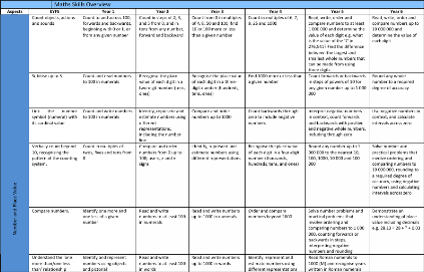 |
Maths Vocabulary Progression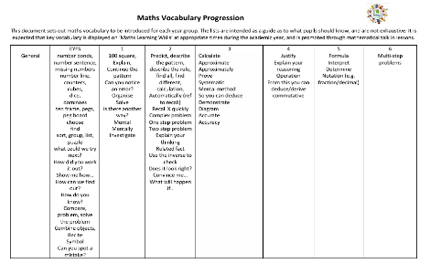 |
Calculation Policy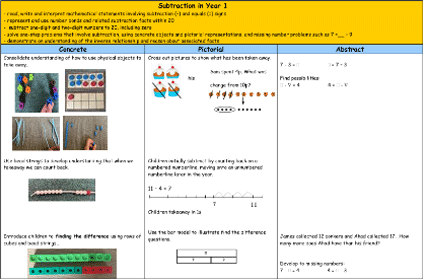 |
Lessons are planned weekly. Connections are made across mathematical ideas to develop fluency, mathematical reasoning and competence in solving increasingly sophisticated problems. There is an emphasis on small-step progression, clear modelling, frequent practice, high quality questioning and oracy (including partner talk, STEM sentences etc).
Teaching assistants are extremely valuable in ensuring all children make good progress throughout each lesson. They are aware of the focus points of each lesson and assist the teacher in delivering high quality lessons. They are guided as to what to do by class teachers but are empowered to use their own judgement to support children to the best of their ability. This may include bridging learning that has occurred in interventions, retrieving appropriate manipulatives, modelling, guiding pupils to look at the learning wall or other visual prompts, marking work, giving verbal feedback or providing encouragement etc. Teaching assistants may support groups or individuals and provide valuable feedback to the teacher.
Inclusion
Children who require additional support are identified on both the year groups’ provision maps and the teachers’ mathematics plans. Lesson adaptations are clear on lesson plans to ensure that everyone receives an ambitious curriculum where everyone can succeed, progress is secure and sustained. Some children take part in mathematical interventions that occur in addition to their usual lessons.
Our approach is inclusive, ambitious and grounded in the belief that all pupils can thrive so adaptations are made clear in the planning. Adaptations come in many forms such as the use of manipulatives, visual prompts, adult support, verbal reminders, specific pairings, open ended problems, proof-based reasoning etc.
Assessment and impact
At Lethbridge Primary School we are continually assessing our pupils and recording their progress. We see assessment as an integral part of the teaching process and endeavour to make our assessment purposeful, allowing us to match the correct learning to the needs of the pupils, thus benefiting the pupils and ensuring progress. Assessment is used to inform teaching in a continuous cycle of planning, teaching and assessment. Children are involved in assessing their own learning: this might include traffic lighting, thumbs up etc.
Formative assessment is made with reference to The National Curriculum programme of study for each year group, and in relation to ‘Development Matters’ in EYFS. Class teachers identify children who are below their expected progress and set up appropriate intervention. SONAR is an online tracking system that Lethbridge uses to bring together assessment and analysis.
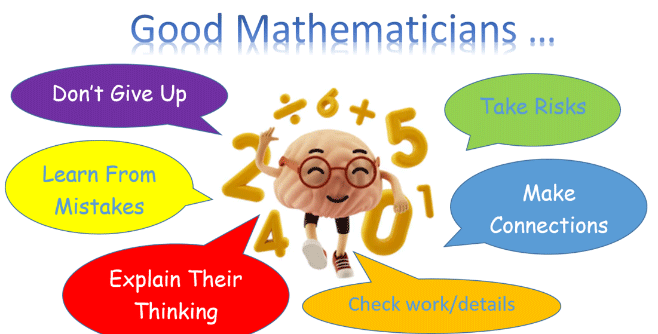
Mathematics has a high profile, where risk taking is encouraged. Mistakes are embraced as opportunities to develop learning, children are given lots of opportunities to share their thinking and children develop the confidence, resilience and competence that ensure that they are ready for secondary school when they leave us in year 6.
|
Lethbridge Primary School
Lethbridge RoadSWINDON Wilts SN1 4BY Telephone: 01793 535033 Email: admin@lethbridge.bluekitetrust.org |
The Blue Kite Academy Trust, a charitable company limited by guarantee registered in England and Wales, Company Number 09889819.

|
Translate using Google: |